

| Price | SGD 6.80 (u.p. SGD 8.50, save SGD 1.70) | |
| Quantity | Max: 20 | |
| Category | Leisure ⊃ Travel, Play ⊃ Games |
| Tags | Crackers, Beans, Water Chestnut |
| Rating |  2 (1 review) 2 (1 review) |
 Feature Hightlight The Boeing 787 Dreamliner is a long-range, mid-size wide-body, twin-engine jet airliner developed by Boeing Commercial Airplanes. Its variants seat 210 to 330 passengers. Boeing states that it is the company's most fuel-efficient airliner and the world's first major airliner to use composite materials as the primary material in the construction of its airframe. The 787 has been designed to be 20% more fuel efficient than the 767 it is to replace. The Dreamliner's distinguishing features include mostly electrical flight systems, a four-panel windshield, noise-reducing chevrons on its engine nacelles, and a smoother nose contour. It shares a common type rating with the larger 777 twinjet, allowing qualified pilots to operate both models, due to related design features. The aircraft's initial designation was 7E7, prior to its renaming in January 2005. The first 787 was unveiled in a roll-out ceremony on July 8, 2007, at Boeing's Everett assembly factory, by which time it had reached 677 orders; this is more orders from launch to roll-out than any previous wide-body airliner.[9] By May 2013, the 787 program had logged 890 orders from 58 customers, with International Lease Finance Corporation (ILFC) having the largest number on order. Development and production of the 787 have involved a large-scale collaboration with numerous suppliers around the globe. Final assembly is at the Boeing Everett Factory in Everett, Washington. Assembly is also taking place at a new factory in North Charleston, South Carolina. Both sites will deliver 787s to airline customers. Originally planned to enter service in May 2008, the project has suffered from multiple delays. The airliner's maiden flight took place on December 15, 2009, and completed flight testing in mid-2011. Final Federal Aviation Administration (FAA) and European Aviation Safety Agency (EASA) type certification was received in late August 2011 and the first model was delivered in late September 2011. It entered commercial service on October 26, 2011. The aircraft has suffered from several in-service problems, notably fires on board related to its lithium-ion batteries. These systems were reviewed by both the FAA and the Japanese aviation agency. On January 16, 2013, the FAA issued an emergency airworthiness directive that grounded all 787s in the U.S. The EASA, Japanese Transport Ministry, India's Directorate General of Civil Aviation (DGCA), and Chile's Dirección General de Aeronautica Civil (DGAC) followed suit and grounded the Dreamliners in their jurisdictions. After Boeing completed tests on a revised battery design, the FAA approved the revised design on April 19, 2013, and lifted the grounding on April 26, 2013. The 787 returned to passenger service on April 27, 2013, with Ethiopian Airlines.&picture=https%3A%2F%2Fsandbox.1buggy.com%2FproductPage%2FView%2FImage%2FDS74vn4tnu0mtabk%2F0%2FOrg%2F01299-Test-Product-%E6%B5%8B%E8%AF%95%E4%BA%A7%E5%93%81-Short-Description.gif&link=https%3A%2F%2Fsandbox.1buggy.com%2FproductPage%2FView%2FDS74vn4tnu0mtabk%2F01299-Test-Product-%E6%B5%8B%E8%AF%95%E4%BA%A7%E5%93%81-Short-Description.html&redirect_uri=https://sandbox.1buggy.com/productPage/SocialPlugsFacebookShareCallback/DS74vn4tnu0mtabk/ "Share on Facebook")     |
01299 Test Product (测试产品) Feature Hightlight
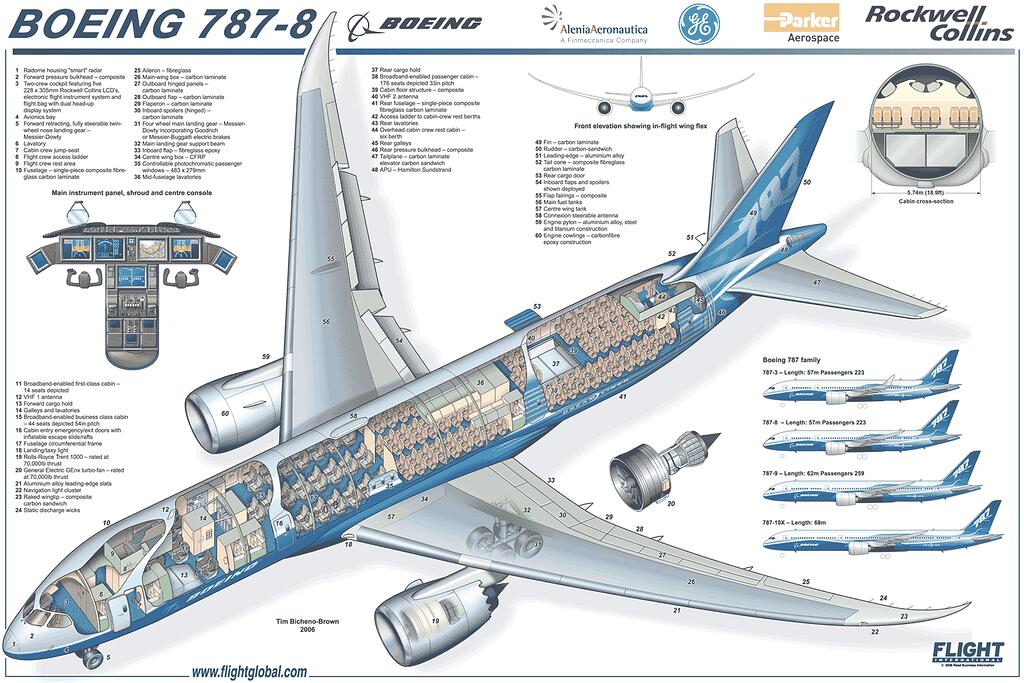
The Boeing 787 Dreamliner is a long-range, mid-size wide-body, twin-engine jet airliner developed by Boeing Commercial Airplanes. Its variants seat 210 to 330 passengers. Boeing states that it is the company's most fuel-efficient airliner and the world's first major airliner to use composite materials as the primary material in the construction of its airframe. The 787 has been designed to be 20% more fuel efficient than the 767 it is to replace. The Dreamliner's distinguishing features include mostly electrical flight systems, a four-panel windshield, noise-reducing chevrons on its engine nacelles, and a smoother nose contour. It shares a common type rating with the larger 777 twinjet, allowing qualified pilots to operate both models, due to related design features.
The aircraft's initial designation was 7E7, prior to its renaming in January 2005. The first 787 was unveiled in a roll-out ceremony on July 8, 2007, at Boeing's Everett assembly factory, by which time it had reached 677 orders; this is more orders from launch to roll-out than any previous wide-body airliner.[9] By May 2013, the 787 program had logged 890 orders from 58 customers, with International Lease Finance Corporation (ILFC) having the largest number on order.
Development and production of the 787 have involved a large-scale collaboration with numerous suppliers around the globe. Final assembly is at the Boeing Everett Factory in Everett, Washington. Assembly is also taking place at a new factory in North Charleston, South Carolina. Both sites will deliver 787s to airline customers. Originally planned to enter service in May 2008, the project has suffered from multiple delays. The airliner's maiden flight took place on December 15, 2009, and completed flight testing in mid-2011. Final Federal Aviation Administration (FAA) and European Aviation Safety Agency (EASA) type certification was received in late August 2011 and the first model was delivered in late September 2011. It entered commercial service on October 26, 2011.
The aircraft has suffered from several in-service problems, notably fires on board related to its lithium-ion batteries. These systems were reviewed by both the FAA and the Japanese aviation agency. On January 16, 2013, the FAA issued an emergency airworthiness directive that grounded all 787s in the U.S. The EASA, Japanese Transport Ministry, India's Directorate General of Civil Aviation (DGCA), and Chile's Dirección General de Aeronautica Civil (DGAC) followed suit and grounded the Dreamliners in their jurisdictions. After Boeing completed tests on a revised battery design, the FAA approved the revised design on April 19, 2013, and lifted the grounding on April 26, 2013. The 787 returned to passenger service on April 27, 2013, with Ethiopian Airlines.
01299 Test Product (测试产品) Terms and Conditions
Boeing 787 battery fundamentally unsafe The lithium ion batteries installed on the Boeing 787 are inherently unsafe, says Elon Musk, founder of SpaceX and owner of electric car maker Tesla. "Unfortunately, the pack architecture supplied to Boeing is inherently unsafe," writes Musk in an email to Flightglobal. "Large cells without enough space between them to isolate against the cell-to-cell thermal domino effect means it is simply a matter of time before there are more incidents of this nature," he adds. Both Boeing and Tesla use batteries fueled by lithium cobalt oxide, which is among the most energy-dense and flammable chemistries of lithium-ion batteries on the market. While Boeing elected to use a battery with a grouping of eight large cells, Tesla's batteries contain thousands of smaller cells that are independently separated to prevent fire in a single cell from harming the surrounding ones. "Moreover, when thermal runaway occurs with a big cell, a proportionately larger amount of energy is released and it is very difficult to prevent that energy from then heating up the neighboring cells and causing a domino effect that results in the entire pack catching fire," says Musk. An aerospace-capable version of Tesla's battery has been developed for use in SpaceX's Falcon 9 space launch vehicle. SpaceX, also owned by Musk, competes with Boeing/Lockheed Martin joint venture United Launch Alliance for customers. Boeing has thus far declined offers of assistance from Tesla and SpaceX, says Musk. "They [Boeing] believe they have this under control, although I think there is a fundamental safety issue with the architecture of a pack with large cells," writes Musk in an email. "It is much harder to maintain an even temperature in a large cell, as the distance from the center of the cell to the edge is much greater, which increases the risk of thermal runaway." Musk's assessments of battery cells were confirmed by Donald Sadoway, a professor of electrical engineering at the Massachusetts Institute of Technology. "I would have used the same words," says Sadoway. "I would have used the same words. I'm glad someone with such a big reputation put it on the line." "He's engineered [Tesla's battery] to prevent the domino effect, while Boeing evidently doesn't have that engineering," adds Sadoway. As a fleet-wide grounding enters its third week, the battery failures on 787s flown by Japan Airlines and All Nippon Airways eariler this month remain under investigation by the US National Transportation Safety Board. Japanese inspectors have cleared the maker of the battery, GS Yuasa, of any defects before the unit leaves the factory. But both Japanese and US investigators continue to examine and test the batteries to understand why they failed after they were integrated into the 787 electrical system and operated on commercial flights. The NTSB, for example, has began a detailed examination of an undamaged 787 battery at a US Navy laboratory, hoping to "uncover signs of any degradation in expected performance". Investigators are trying to find the answer to a problem that eluded Boeing and the FAA in the certification phase, even though the manufacturer and the regulator were well aware of the risks posed by lithium-ion batteries. Mike Sinnett, Boeing's 787 chief project engineer, explained the careful design philosophy employed for the 787's battery system, the first to serve as a starter for an auxiliary power unit and emergency power back-up in a commercial aircraft. "I design a cell to not fail and then assume it will and the ask the next 'what-if' questions," Sinnett said. "And then I design the batteries that if there is a failure of one cell it won't propagate to another. And then I assume that I am wrong and that it will propagate to antoher and then I design the enclosure and the redundancy of the equipment to assume that all the cells are involved and the airplane needs to be able to play through that."
 Home
Home Malaysia
  Singapore
  Back to top